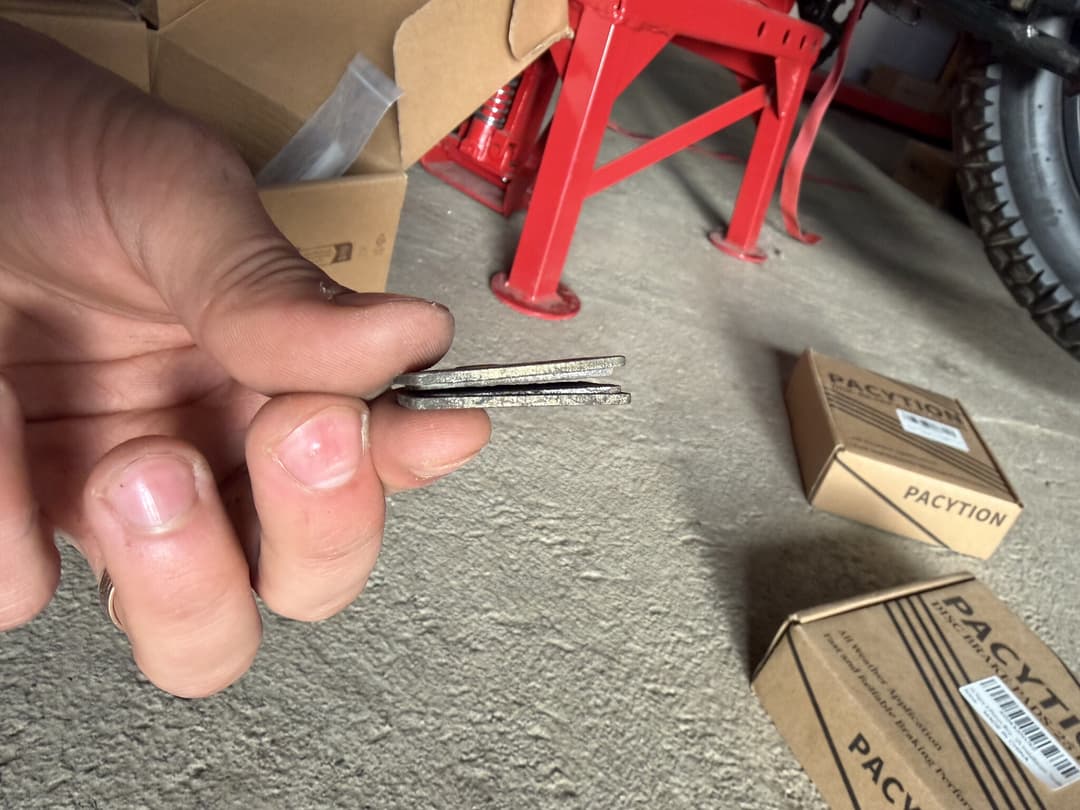
worn to backing plate fails the wear check
The judgement the shop actually cares about. Pads worn through to metal must not pass a check asking whether usable material remains. THE ACCEPTANCE RULE WAS THE DEFECT, not the agent. It read 'close enough to judge whether any usable thickness remains' — a requirement about the PHOTOGRAPH, which a sharp side-on shot of ruined pads satisfies to the letter. The Inspector said so: 'making it easy to judge that virtually no usable friction material remains', verdict PASS at 0.95. It saw the pads perfectly and answered the question the words asked. A rule that describes what must be VISIBLE instead of what must be TRUE cannot fail, and no prompt can rescue it without overriding the procedure, which is the one thing the Inspector must never do. This is the defect class the Auditor exists to find: a step everybody reads differently. Restated as a condition, in the same shape as the rule on the step that passes.
The answer conformed to the contract and every assertion held.
System instructionassembled from the contract schema, not hand-written
Return exactly one verdict for the evidence supplied against this step. PASS only if the acceptance rule is satisfied by what you can actually see. THAT THE EVIDENCE IS CLEAR ENOUGH TO JUDGE IS NOT ITSELF A PASS: a sharp, well lit, entirely legitimate photograph showing the acceptance rule is NOT met is the commonest way a step fails, and passing it because the photograph is good is the single worst mistake you can make. Where the acceptance description says what must be visible rather than what must be true, read it as the condition the step exists to establish — the step explanation tells you which. ADD_FIELD when the evidence is insufficient but recoverable, and name what specifically was wrong with it. ESCALATE when a person must decide — INCLUDING when the evidence is entirely sufficient and shows the acceptance rule is not satisfied. Asking for another photograph of a condition you can already see is not a remedy.

Return JSON with these fields:
- verdict (one of PASS | ADD_FIELD | ESCALATE, required)
- confidence (number, required): 0 to 1: YOUR CONFIDENCE THAT THE ACCEPTANCE RULE IS SATISFIED by this evidence. Not how sure you are of your verdict, and not how good the photograph is — a perfectly clear photograph of a rule being broken is high certainty and LOW confidence, because the rule is not satisfied. Evidence you were never shown cannot make you confident of anything. Below the strictness threshold you must not return PASS, and a threshold in ordinary code enforces that whatever you return.
- rationale (string, required): One or two sentences citing what in the evidence decided it. Never restate the prompt.
- add_field_key (string, null when it does not apply): Required when verdict is ADD_FIELD. A new key, not an existing one.
- add_field_kind (one of measurement | photo | video | scan | choice | text | signature | location, null when it does not apply)
- add_field_prompt (string, null when it does not apply): The specific next ask, e.g. 'the label is out of focus, photograph it again'. Never a generic retry.
- escalation_question (string, null when it does not apply): Required when verdict is ESCALATE. The exact unresolved question for the person, not a summary.
- observed (string, null when it does not apply): Required when the acceptance rule is `matches`. TRANSCRIBE, character by character, exactly what you can read in the evidence — not what it ought to say. Never copy the expected value into this field; it is the one field in this answer that must come from the image alone. Where a character is illegible write `?` in its place. The comparison against the expected value is then made in ordinary code, not by you, which is the whole point: an agent told what it is looking for will find it.
## The step
{
  "title": "Check remaining pad material before deciding to replace",
  "why it exists": "Pads worn to the backing plate destroy the disc, which turns a 40 pound job into a 300 pound one, and the bike is unsafe long before that."
}

## The field you are judging
{
  "key": "pad_material_remaining",
  "kind": "photo",
  "asked of the technician": "Photograph the pads in place so the remaining material can be judged",
  "source": "camera",
  "what good looks like": "Side on to the pad edge is what shows thickness. Straight at the face shows nothing.",
  "acceptance": "acceptance_rule: must_show; the media must show: usable friction material still remaining above the backing plate, seen side on so the thickness can be judged"
}

## What a PASS would assert
That this is true of the machine: usable friction material still remaining above the backing plate, seen side on so the thickness can be judged.
The step exists because: Pads worn to the backing plate destroy the disc, which turns a 40 pound job into a 300 pound one, and the bike is unsafe long before that..

State what the evidence shows about that assertion BEFORE you choose a verdict, and put it in your rationale. If what you can see makes the assertion FALSE, the verdict is not PASS — however sharp, well lit and honest the photograph is. Asking for another photograph of a condition already visible is not a remedy, so that case is an ESCALATE, not an ADD FIELD.

## Conditions
{
  "strictness": "2 (assured)",
  "confidence a PASS must clear": 0.75,
  "add field budget": "0 of 2 ADD FIELD requests on this step are already spent.",
  "capture surface": "app_instrument",
  "capture mode": "live"
}
## The evidence The image below is what the technician captured for this field. Judge what you can actually see in it. If you cannot see enough to decide, say what specifically is missing — never ask for a generic retry.
{
  "verdict": "ESCALATE",
  "confidence": 0.95,
  "rationale": "The photograph clearly shows the pads from a side-on perspective, but they are extremely worn with almost no usable friction material remaining above the backing plates.",
  "add_field_key": null,
  "add_field_kind": "photo",
  "add_field_prompt": null,
  "escalation_question": "The brake pads are worn down almost entirely to the backing plates with virtually no usable friction material remaining. Should they be replaced?",
  "observed": null
}Assertions pin the part of an answer that decides something, never the whole object — exact-matching a rationale would fail the first time it was reworded, and a suite that cries wolf is abandoned inside a day. Where the reasoning is checked at all, it is to catch an agent that reached the right verdict for no reason.
| asserted | about | what happened | |
|---|---|---|---|
| ok | not_in | verdict | is ESCALATE, must not be one of ['PASS'] |
| ok | mentions_any | rationale | found ['worn', 'backing'] |